
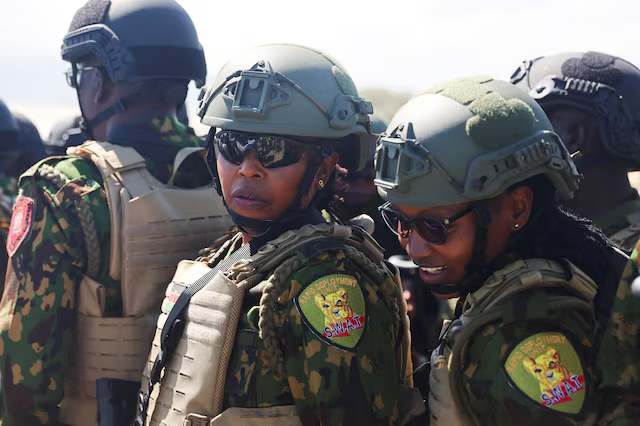
Port-au-Prince, 10 Dec – Another Kenyan Airways charter landed at Toussaint-Louverture on Monday, disgorging 230 fresh-faced officers in crisp blue berets. They arrived to the same soundtrack that has greeted every foreign contingent since 2004: distant automatic fire, the sour smell of burned tires, and a capital whose map was redrawn by gangs while the plane was still in the air.
The math is brutal.
- 980 multinational officers are now in-country.
- 5 500 are authorised.
- 12 000–15 000 gang combatants control 85 % of greater Port-au-Prince, including every major corridor to the north and south, according to the UN’s own 3 December sit-rep.
- Since September – the same month the Security Council voted to turn the under-powered “Multinational Security Support” mission into a bigger “Gang Suppression Force” – the Viv Ansanm coalition has added three new neighbourhoods (Pétion-Ville’s Vivy Mitchell, Carrefour’s Fort-Dimanche, and the port entrance at Varreux) without firing more than a few magazines. Local police simply abandoned posts when ammunition ran out.
In other words, the territory under gang authority grew faster than the mission’s manpower. The arrival of one extra Kenyan company does not even replace the 254 officers who have already rotated home since February, let alone surge to the 2 500 planners once called the “minimum credible footprint”.
What the new contingent can do
- Secure the airport-to-Palais-National axis for a few daylight hours.
- Escort humanitarian convoys that previously moved only with armoured-vehicle windows cracked open.
- Free up 60 exhausted Haitian SWAT officers who have been sleeping in the terminal for three weeks because their base in Delmas 6 is now a gang checkpoint.
What it cannot do
- Retake the Artibonite valley, where gangs torched 300 hectares of rice last month and forced 15 000 farmers inland.
- Re-open the southern highway; the Kenyan convoy itself had to helicopter from the tarmac to the Montana Hotel – the road from the airport is still a no-go after 16:00.
- Interdict the 9 mm and 5.56 mm cargo that lands weekly on small boats at Ganthier and Malpasse – weapons that, according to a 6 December U.S. federal indictment, are bought in Florida gun stores for less than the price of a Miami dinner.
The funding cliff
Washington’s $1 billion in “in-kind” support pays for fuel, med-evac helicopters and three meals a day, but it does not buy bullets, pay salaries or replace the two Kenyan APCs lost to IEDs in September. The UN trust fund – meant to bankroll the mission – has been stuck at $113 million since August. At current burn-rate that covers four months of operations, not the $800 million annual bill the UN itself signed off on. Without fresh cash, the force will start rationing patrol kilometres by March, planners privately warn.
Gang counter-moves
Intelligence briefings shared with The Straits Times show Viv Ansanm has already shifted tactics:
- “Checkpoint franchising” – smaller cells now tax vehicles at $50 a passage instead of burning them, raising war-chests while avoiding headline-grabbing massacres.
- Night-time repositioning – fighters move in 12-man units on motorcycles after 22:00, when foreign patrols are back inside secured perimeters.
- Information blackout – in neighbourhoods they seized last month, gangs confiscate SIM cards and impose a 48-hour “communication curfew”, making it almost impossible for residents to tip off incoming Kenyan units.
What happens next – three scenarios
- Static Stalemate (probability: 60 %)
The extra 230 Kenyans hold the airport-Portail-Léogâne triangle, gangs keep everything else. Monthly kidnappings stay above 1 200, inflation tops 25 %, another 200 000 people flee by Easter. Mission commanders label it “stabilisation” because the capital doesn’t fall into the sea. - Symbol-Driven Offensive (30 %)
Under pressure to show results before the U.S. election cycle, the mission launches a headline-grabbing but under-resourced push into Cité Soleil. A week of TikTok-ready house-clearings is followed by a Kenyan withdrawal for lack of holding troops. Gangs re-infiltrate within 72 hours, now armed with captured Kenyan radios. - Funding Collapse & Partial Withdrawal (10 %)
The trust fund hits zero in Q2-2025. Kenya, already facing budget cuts at home, refuses to carry the load alone. Washington offers more helicopters but no cash. By summer the mission shrinks to 450 personnel confined to the airport and the Montana Hotel – a de-facto green zone. The Haitian government, never elected and now bereft of military cover, negotiates a tacit cease-fire with Viv Ansanm that amounts to recognition of gang sovereignty over half the capital.
Bottom line
The 230 officers who stepped onto Haitian asphalt Monday are not reinforcements; they are a bookkeeping entry against an enemy that adds fighters faster than the mission adds dollars. Until either the budget or the rules of engagement change, every new deployment is simply resetting the clock on the next gang advance – and the map keeps bleeding red.
Discover more from Haitianprimenews.com
Subscribe to get the latest posts sent to your email.


Discussion about this post